
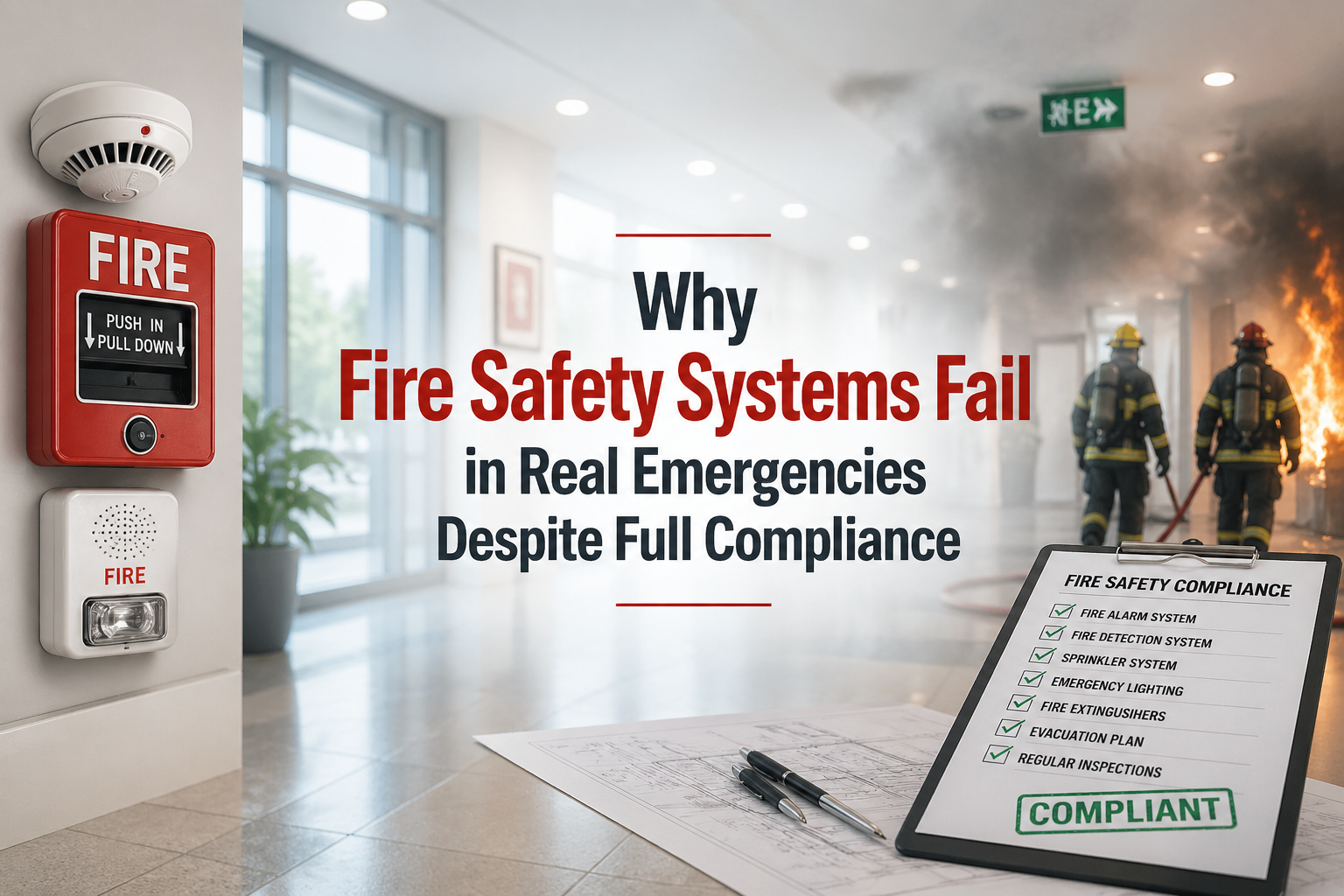
Why Fire Safety Systems Fail in Real Emergencies Despite Full Compliance
Many building owners and safety managers assume that once a system is “compliant,” it is fully reliable. However, real-world incidents often tell a different story. The fire safety system failure reasons are more complex than just maintenance or installation issues. In fact, understanding fire safety system failure reasons is critical because even compliant buildings experience unexpected breakdowns during emergencies. Most importantly, ignoring fire safety system failure reasons can lead to delayed response, system malfunction, and increased risk to human life when it matters the most.
From high-rise offices to residential complexes, compliance certificates often create a false sense of security. But emergencies do not follow documentation—they expose real performance gaps.
Compliance vs Real-World Performance: The Hidden Gap
A major misconception in fire safety is that compliance equals readiness. While regulations ensure minimum standards, they do not always guarantee performance under stress conditions. This is where most failures begin.
Many systems are tested in controlled environments, but emergencies are chaotic, fast-changing, and unpredictable. This gap between design expectations and real-life performance often becomes the root cause of failure.
One of the most overlooked compliant fire safety systems failure causes is over-dependence on periodic inspections without real-time stress testing.
Why Fire Systems Fail Even When They Are “Approved”
Even certified systems can fail due to multiple interconnected issues:
- Lack of integration between fire alarms and suppression systems
- Delayed signal transmission during power failures
- Poor calibration of sensors in dusty or humid environments
- Human delay in responding to alerts
This explains why fire alarms fail during emergencies even when they are fully installed and certified. Often, the system works in isolation but fails when multiple components must respond together under pressure.
Maintenance Is Not the Only Problem
Many assume maintenance is the only factor behind failure. However, the reality is broader. Structural design, system integration, and human behavior all play critical roles.
In many cases, maintenance logs are updated, but actual performance checks are not conducted under simulated emergency conditions. This leads to a false assumption of safety readiness.
This is where we often see gaps in fire protection system performance, especially in older buildings where upgrades are partial or inconsistent.
Real-World Emergency Breakdown: What Actually Happens
During actual emergencies, fire safety systems are expected to perform in seconds. However, delays of even 30–60 seconds can be critical.
A typical breakdown includes:
- Fire detection delay due to sensor blind spots
- Alarm activation without evacuation coordination
- Sprinkler systems activating late or unevenly
- Communication failure between control rooms and occupants
This real incident fire safety system breakdown analysis shows that the issue is not always system absence—it is system inefficiency under pressure.
Human Factor: The Most Unpredictable Element
Even the most advanced systems depend on human response. Panic, confusion, and lack of training can override automated safety protocols.
For example, occupants may ignore alarms assuming false triggers. Security staff may delay activation of manual overrides. These behavioral delays can completely neutralize system advantages.
The Compliance Illusion in Modern Buildings
Today’s buildings often pass inspections but still fail during real emergencies. This creates what experts call the “compliance illusion”—a belief that certification equals safety.
In reality, compliance checks focus on documentation, not dynamic emergency simulation. This leads to unnoticed vulnerabilities in evacuation flow, system synchronization, and emergency communication.
Such limitations of fire safety compliance in buildings highlight why periodic audits alone are not enough.
Why System Integration Matters More Than Individual Components
A fire safety system is not just alarms or sprinklers—it is an interconnected network. If one component fails, the entire chain is affected.
Common integration issues include:
- Fire alarm not linked to ventilation shutdown
- Sprinklers not synced with alarm triggers
- Emergency exits not illuminated automatically
- Central control panel delays in data processing
This interconnected failure often becomes one of the leading fire safety system failure reasons in high-density buildings.
Training and Awareness: The Missing Layer
Even advanced systems cannot compensate for lack of awareness. Regular fire drills, evacuation training, and role-based responsibilities are essential.
Without training:
- Occupants hesitate during evacuation
- Emergency routes become congested
- Panic spreads faster than the fire itself
This human delay often determines the final outcome more than the system itself.
How Modern Fire Safety Can Improve Reliability
To reduce failures, organizations must go beyond compliance and focus on resilience:
- Conduct real-time simulation drills
- Integrate AI-based monitoring systems
- Upgrade legacy detection systems
- Ensure cross-system communication testing
- Train occupants regularly for emergency response
Only then can the gap between compliance and actual performance be reduced.
Conclusion
Fire safety is not just about installation—it is about performance under pressure. Many buildings today are compliant on paper but vulnerable in reality. The true challenge lies in understanding that safety systems are only as strong as their weakest interaction point.
Instead of relying solely on certifications, organizations must continuously evaluate real-world readiness. Because in emergencies, it is not the system on record that matters—it is the system that actually works.