
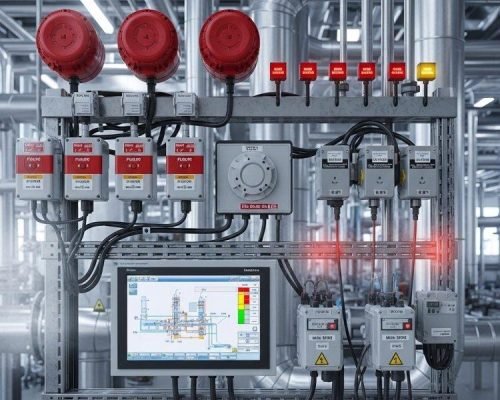
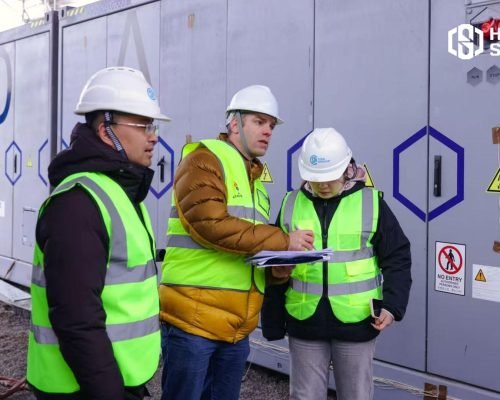
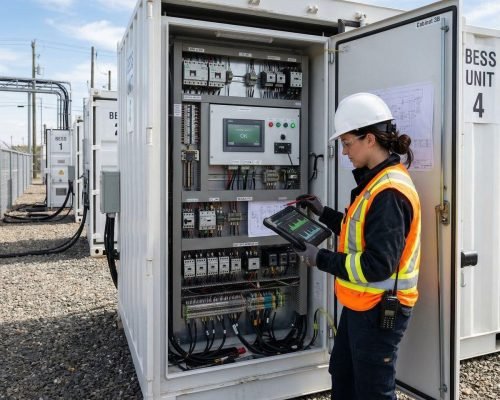
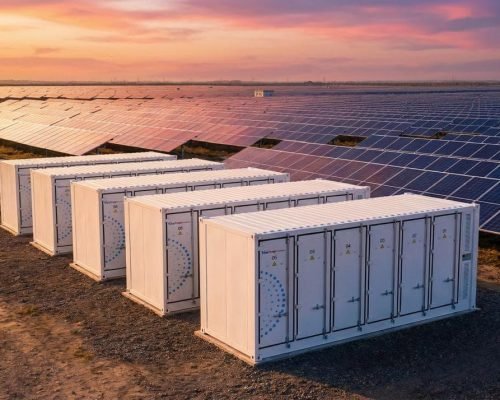
Integrated fire safety solutions for Battery Energy Storage Systems, covering early thermal runaway detection, off-gas detection, fire detection, suppression, container protection, site-level fire protection, testing, commissioning and lifecycle support.
Battery Energy Storage Systems (BESS) are becoming an important part of modern power infrastructure, supporting renewable energy, grid balancing, peak demand management and industrial energy storage.
At the same time, lithium-ion battery systems require a carefully engineered approach to fire safety. A BESS fire-protection strategy cannot rely on a single extinguisher or suppression technology. Detection, alarm, battery management, ventilation, emergency shutdown, suppression, cooling, site fire protection and emergency response need to work together.
Oustfire provides integrated BESS fire safety and fire protection solutions for containerised, cabinet-based and battery-room energy storage applications.
Battery energy storage systems can contain a large number of interconnected cells, modules and racks within a relatively compact installation. A failure at the cell level can develop into thermal runaway and, depending on the system design and conditions, can result in fire, smoke, hazardous gases or propagation to adjacent components.
Temperature, voltage, gas and other monitored parameters can provide important indications of abnormal battery behaviour.
A battery cell may enter an uncontrolled thermal reaction. Early detection is important for initiating the appropriate safety response.
Battery incidents may involve off-gases, smoke and heat. Detection technologies should therefore be selected according to the battery system and hazard assessment.
A fire-protection strategy should consider cell, module, rack, enclosure and site-level risks rather than treating the battery system as a conventional electrical room.
Effective BESS fire safety starts with early detection and continues through equipment-level protection, container protection, site fire protection and lifecycle management.
The first layer focuses on identifying abnormal conditions before they develop into a major fire event.
Protection at the battery equipment level helps identify and respond to abnormal conditions within modules and racks.
Containerised BESS installations require coordinated detection, alarm, suppression, ventilation and emergency response arrangements.
Utility-scale and large commercial BESS projects may require protection beyond the individual battery enclosure.
Fire protection does not end after installation. Periodic inspection, testing, maintenance and emergency preparedness are important parts of the BESS safety lifecycle.
The right technology depends on the battery chemistry, system architecture, enclosure, project conditions, applicable requirements and hazard assessment.
Early detection technologies designed to identify abnormal battery conditions and provide an opportunity for rapid safety response.
Detection of battery gases or VOC-related indicators can provide an additional early-warning layer where appropriate.
Detection systems selected according to the enclosure, environment and expected fire-development characteristics.
Suppression technologies may include water-based systems, water mist, clean agents, aerosols or other engineered approaches depending on the application.
Integrated protection for containerised BESS including detection, suppression, alarms, controls and safety interfaces.
Integration between detection, suppression, BMS, EMS, emergency shutdown and site fire alarm systems.
Site-level fire water infrastructure including hydrants, pumps, storage and engineered water-based protection where required.
Periodic inspection, testing, maintenance and lifecycle support for BESS fire protection systems.
Fire detection and protection strategies for large grid-connected energy storage installations.
Integrated fire safety for renewable-energy projects combining solar generation and battery storage.
Protection strategies for commercial and industrial energy storage installations.
Detection, suppression and safety integration for containerised battery energy storage systems.
Fire detection and protection solutions for indoor battery energy storage environments.
Fire protection for distributed energy storage and critical-power applications.
Review battery chemistry, capacity, layout, container configuration, OEM information and project requirements.
Identify fire, thermal runaway, smoke, gas and propagation hazards relevant to the installation.
Develop the detection, alarm, suppression and site-level fire-protection strategy.
Execute installation, integration and system interfaces according to approved engineering documentation.
Carry out inspection, testing and commissioning of the fire-protection and detection systems.
Support the system through periodic inspection, maintenance, training and lifecycle service.
BESS fire safety requirements can involve Indian regulations, project specifications, battery OEM requirements, electrical and fire-safety requirements, insurance requirements and internationally recognised standards and test methods.
Depending on the project, relevant references may include requirements associated with CEA, NFPA, UL, IEC and applicable local fire-safety authorities.
Standards and certification claims should always be verified against the specific product, system configuration, edition and project requirement.
India's energy-storage sector is developing rapidly, and BESS projects need to consider applicable electrical, fire-safety, environmental, project and authority requirements.
The Central Electricity Authority (CEA) has published regulations and BESS-related safety material that project developers, EPC companies, consultants and safety teams should review when planning energy-storage installations.
Establish the fire-safety philosophy early during project planning so that detection, suppression, access, emergency response and site infrastructure can be coordinated.
Fire protection should be coordinated with battery containers, electrical systems, BMS/EMS, site utilities and the overall project design.
Technical documentation should clearly define the hazard, detection philosophy, suppression strategy, interfaces, testing requirements and applicable standards.
Emergency procedures, inspection, testing, training and periodic fire-safety review should be incorporated into the operational lifecycle.
Explore practical information for developers, EPC companies, consultants, electrical engineers and fire-safety professionals.
Detection, suppression, alarm, water-based protection and safety interfaces can be considered as part of one coordinated fire-protection strategy.
Solutions should be selected according to battery architecture, project conditions, applicable requirements and the identified hazard.
Support can extend from initial technical discussion and design coordination through installation, testing and commissioning.
Inspection, maintenance, training and periodic testing help maintain fire-protection readiness after commissioning.
A BESS fire suppression system is part of an integrated fire safety strategy designed for battery energy storage systems. Depending on the application, it may include fire detection, gas or off-gas detection, alarms, automatic suppression, cooling, emergency shutdown and site-level fire protection.
Thermal runaway can occur when a battery cell experiences an uncontrolled increase in temperature and associated internal reactions. The initiating cause can vary and may involve electrical, mechanical, thermal, manufacturing or operational factors.
Some BESS detection technologies are designed to identify abnormal conditions or gases that may occur before visible flames develop. The appropriate detection approach depends on the battery technology, enclosure, system design and hazard assessment.
Water-based protection can play an important role in certain BESS fire-safety strategies, particularly where cooling and propagation control are required. The appropriate system depends on the project design, battery system, applicable requirements and engineering assessment.
Off-gas detection refers to detecting gases released from batteries during abnormal conditions. Depending on the technology and application, gas detection can provide an additional early-warning layer before a developing battery event becomes a larger fire incident.
UL 9540A is a test method used to evaluate the thermal runaway fire propagation characteristics of battery energy storage systems. Its role and test results should be considered together with the complete project design and applicable requirements.
NFPA 855 is a standard addressing the installation of stationary energy storage systems. Project teams should determine which requirements apply to their specific installation and jurisdiction.
No. The fire-protection strategy should be selected based on factors such as battery chemistry, system architecture, enclosure, capacity, installation environment, project requirements, hazard assessment and applicable standards.
Oustfire can discuss BESS fire detection, suppression and site-level fire-protection requirements and help develop an appropriate project-specific solution based on the available technical information.
Share your BESS project details with our team. We can review the available information and discuss the fire detection, suppression, container protection and site-level fire-safety requirements.
Technical note: BESS fire protection requirements vary by project. Final system selection should be based on the battery system, OEM documentation, project design, applicable Indian regulations, relevant standards, authority requirements and a project-specific hazard assessment. Product certifications and test reports should be verified for the exact product and configuration being proposed.